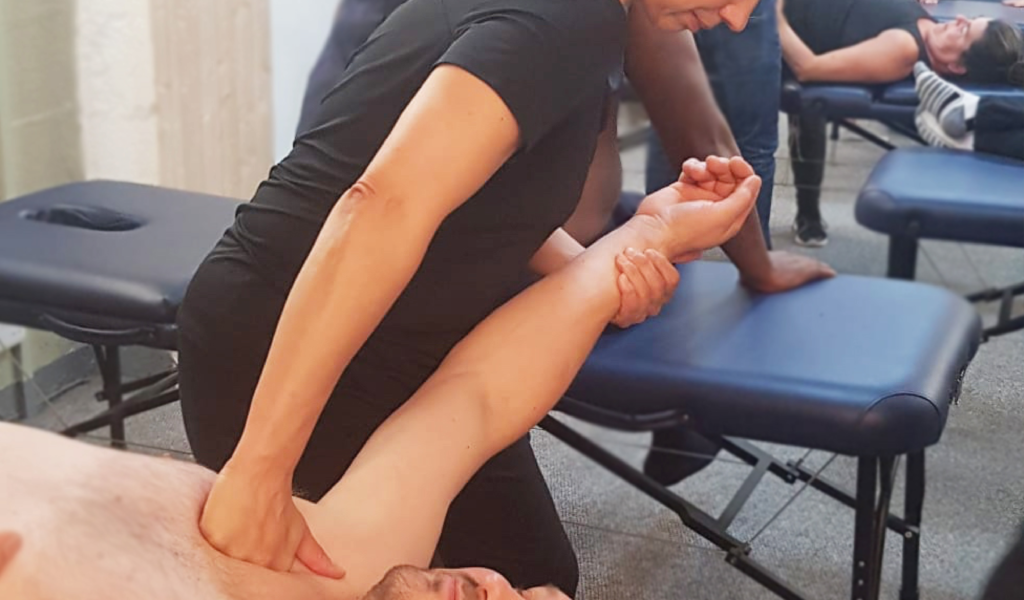
ITEC Level 3 – 5 Diploma in Clinical Sports & Remedial Massage – Spa Conversion Course

Qualification Number (QN): 603/4501/9
Advance your teams expertise with the BTEC Level 5 flexible diploma programme. Aimed at existing spa therapists who wish to upskill their massage and expertise at clinical level, spas will be empowered to offer advanced sports, remedial and clinical massage to spa guests.

Course Overview

The School of Natural Therapies offer this unique clinical sport and remedial massage training with our popular two-step programme, which utilises spa therapists existing knowledge and massage skills, in order to upskill them to the level required to achieve a qualification which is equivalent to a university under-graduate level of education.

This customised qualification is highly sought by industry professionals, in-house gyms and sports clubs because of the high level of robust clinical skills and theoretical knowledge taught; clinical therapists are therefore able to effectively assess and treat injuries to an advanced skill level with effectiveness and results.

On successful completion of both elements, students will be awarded the following certificates:

  • An ITEC Level 3 Diploma in Sports Massage – students will achieve this qualification within the first 3 months of the full programme.
  • A BTEC Level 5 Diploma in Clinical Sport, Remedial Massage & Soft Tissue Therapy
  • A certificate from the of School of Natural Therapies (SNT) which will state – ‘Level 5 Clinical and Remedial Sports Massage Diploma’
  • Membership of the ISRM (Association for Soft Tissue Therapists)

The full programme is made up of theoretical and practical skills, underpinned by set detailed case studies and assignments. Its is taught by two experienced professionals who operate their own well established clinics during weekdays and have a passion to pass on their knowledge, skills and industry advice.

We can produce a bespoke programme to suit the working environment of the spa on agreed day, dates and time spans.

For some of the theoretical elements of the syllabus (such as A&P) we can usually offer live online zoom sessions at agreed set times, allowing spas even more flexibility with busy spa times and days – often in the past we have delivered these live online sessions during early evenings from 6.30 to 8.30pm.

‘This training provided invaluable insights, tools and techniques to support guests during their treatment or recovery journey. Our team is now equipped to deliver therapy to the highest and safest standards. It was a well designed program that offered the perfect approach our team to confidently support guests‘.

Marion Kapellas, Spa Director, The Connaught (Aman Spa)

Attendance Type
Blended Learning
Qualification
Level 3 and Level 5 Diploma
Duration
9-10 months part-time course

Accredited by

Entry Requirements

We ask that spa therapists put forward for this programme are established within the spa team and are in possession of good written and spoken English language skills.

Therapists must hold a current Level 3 qualification in beauty or massage, that is UK regulated.

Examples of awarding bodies that are acceptable are: ITEC/VTCT, CIDESCO, CIBTAC, etc. 

It is also useful but not essential to have some knowledge of experience of movement disciplines, such as exercise (eg PT) sport or dance.

Course Structure

The FULL Level 3/Level 5  course structure is as follows:

  • ITEC Level 3 Diploma in Sports Massage Therapy – which takes place over 3 months, part-time – plus an additional ITEC exam day (date to be agreed on discussions)
  • For the Level 5 Bridging Programme a further period of 12 days must be completed. We usually suggest the dates in blocks of two days over a 6 month period, to allow for course work to be completed.
  • The final Level 5 exam consists of a one hour practical assessment.
  • A Portfolio of case studies is also required – full details will be provided on application.

The advantages of studying a 2-step programme such as this are:

  • It allows therapists (or the spa) to obtain insurance to practice, once qualified in sports massage at Level 3, whilst therapists are working towards the Level 5 programme.
  • It allows the spa to establish itself as a provider of sports massage earlier whilst spa therapists are simultaneously working towards the development of their level 5 functional skills.


iUSP160 – Functional Anatomy & Physiology for Sports Massage

Students will learn how to understand the structural organisation of the human body, in relation to sports massage application; these areas include:-

  • Human cells and tissues
  • The structure and function of the Skin
  • The structure and function of the Skeletal system, including joints and categories of joints, ligaments and tendons
  • The structure and function of the Muscular System and the location and function of relevant muscles in the body
  • The structure and function of the Nervous System
  • The structure and function of the Endocrine System
  • The structure and function of the Cardio-vascular system
  • The structure and function of the Lymphatic System
  • The structure and function of the Respiratory system
  • The structure and function of the Digestive System
  • The structure and function of the Urinary System

This unit will be assessed by an externally set multiple choice question paper (25 questions) on exam day.

iUSP174 – Principles of Health & Fitness.

  • The benefits of an active healthy lifestyle
  • The effects of exercise on the body
  • The components of fitness
  • The principles of training
  • Nutrition – the role of micro/macro nutrients, hydration and healthy eating and how this relates to growth, repair and injury.

This unit will be set as a combination of classroom lectures and home assignment work

iUSP150 – Professional Practice in Sports Massage

  • Sports Massage Legislation
  • Scope of practice in the sports massage industry, including awareness and understanding of caution, contra-indications and interface with other professionals and therapists.
  • Professional Standards and regulations, pertinent to the industry
  • Legal obligations, legislation and client record keeping

This unit will be set as a combination of classroom lectures and home assignment work

iUSP181 – Understanding the Principles of *Soft Tissue Dysfunction

*Soft tissue is an anatomical term to categorise the tissues that connect, support, or surround other structures and organs of the body, other than bone. This includes tendons, ligaments and muscle fascia, amongst other tissue and is relevant therefore to the sports massage industry. Learners will therefore understand –

  • Soft Tissue Dysfunction and the process of repair of this tissue, including causes and types of injury and damage.

This unit will be set as a combination of classroom lectures and home assignment work

iUSP178 – Applying Sports Massage Treatment

Learners will gain the knowledge, theory and skills to understand and apply –

  • The history, origins and development of sports massage
  • Sports massage techniques* and tools and apply them as sports massage treatments
  • Equipment and its adaptation/modification in relation to different environments and events.
  • Identifying contra-indications and contra-actions before, during and after massage treatment
  • Assessing and screening clients for sports massage treatments
  • Consultation and client assessment recording methods
  • Devising a suitable massage strategy for each client and their specific needs/requirements and carrying out an effective and safe treatment.
  • Develop and ensure good posture whilst working and making effective use of massage equipment, including massage couch, oils and massage mediums.
  • Working to good professional standards of practice, ensuring that hygiene and sterilisation is observed at all times.
  • Monitoring client communication and feedback.
  • Evaluating the outcomes and effectiveness of the massage strategy and treatment in every case.
  • Post massage analysis and aftercare advice and guidance.

Techniques will include :

  • Effleurage
  • Petrissage
  • Friction
  • Tapotement
  • Vibration
  • Neuro-Muscular Technique (NMT)
  • Pre/Post/Inter-Event Massage
  • Other specific sports massage techniques

Level 5 Advanced Massage

  • Understanding the Principles and Application of Cross Fibre Frictions
  • An understanding and working in depth with the Psoas muscle

Level 5 Biomechanics, Joint assessment and specialised Tests

  • Revisit Postural Assessment 
  • Learn how to undertake specialised function and mobility tests
  • Common injuries
  • Professional methods of note-taking and case histories
  • Remedial Exercise Advice
  • Trunk/Core Stability

Level 5 Soft Tissue Release (STR)

  • Principle and application of technique
  • Active and Passive techniques
  • Weight-bearing
  • Clinical usage
  • Contra-indications

Level 5 Muscle Energy Techniques (METs)

  • Principle and application of technique
  • Post Isometric Relaxation (PIR) methods
  • Reciprocal Inhibition (RI) methods
  • Contra-indications

Level 5 Preparing to set up a successful clinical practice

  • Business Practice
  • Working outside and at major sporting events

Level 5 Neuromuscular techniques

  • Understanding of the genesis of trigger points
  • Pain and referred pain
  • The impact on muscle function
  • Deactivation methods

Level 5 Connective Tissue Massage

  • Myo-fascial release techniques 
  • Understanding application and impact

Level Positional Release Techniques

  • Working with muscles in spasm
  • Releasing chronically congested fascial tissue

Assessment

ITEC Level 3 Programme

3 assignments, plus 3 case studies are required as part of the course. On exam day there is a 50 MCQ theory paper and a 1 hour practical exam.

BTEC Level 5 Program

    • Final practical assessment on the scheduled exam day.
    • Three other practical assessments are also carried out during the course
    • Three theory/research written assignment papers need to be submitted prior to certification.
    • Three case study reports also need to be submitted prior to certification.
    • Three internal muscle tests are also carried out during the course

Assessment and exam dates are agreed in advance on application and in agreement with the spa team/manager.

We do factor in plenty of time to revisit and practice all techniques learned on the L5 programme, in order for students to be able to consolidate these techniques into a cohesive treatment programme, and for their case study work.


Tutors

Joseph O'Dwyer, Director of Sport & Remedial Studies

Joseph O'Dwyer

Director of Sport & Remedial Studies

Trevor Gorard, Sport & Remedial Studies Tutor

Trevor Gorard

Sport & Remedial Studies Tutor

Latest Reviews

Google Icon 4.8
★★★★★
(236 Reviews)

Read our verified course reviews, submitted by real students, and explore all our testimonials on Google Reviews.

FAQs

If you have any questions about this course, please do not hesitate to contact us and we’ll be happy to answer any questions you may have.

Next Steps

Ready to secure your space?

Need more information?

Individual Learners

To enrol on this course as an individual rather than book as a team, secure your space below 

Level 5 Diploma in Clinical Sports & Remedial Massage (Including ITEC Level 3 Diploma)

Qualification Number (QN): 603/4501/9
Advance your expertise with the Level 5 Diploma, focusing on sports injuries and remedial care. This 10 month course is perfect for professionals.
ITEC Level 3 – 5 Diploma in Clinical Sports & Remedial Massage – Spa Conversion Course
  Accredited Qualification
  ISRM Membership
  Two-Step Programme
  Flexible delivery to suit spas

Our Venue

This content is provided by Google Maps, which may set cookies. It is not loaded unless you choose to see it.

Cookie settings

Unit 54, Battersea Business Centre, 99–109 Lavender Hill, Battersea, London SW11 5QL