Sports massage is one of the most in-demand areas of complementary healthcare in the UK, and it is easy to see why. From elite football clubs to corporate wellness programmes, trained therapists who can assess, treat and support soft tissue health are sought after across a wide range of settings. If you are considering a career change or are simply looking for a vocation that is both physically and intellectually rewarding, this guide covers everything you need to know, from the qualifications involved to what your working life could look like once qualified.
What does a sports massage therapist actually do?
Sports massage therapists assess and treat soft tissue conditions, including muscles, tendons, ligaments and fascia. The work is not limited to athletes, despite the name. Therapists regularly work with people experiencing postural issues, occupational strain and general muscular discomfort, as well as those recovering from injury or preparing for physical performance.
At a more advanced level, therapists trained to Level 5 standard carry out detailed biomechanical assessments, apply specialist techniques such as Soft Tissue Release (STR) and Muscle Energy Techniques (METs), and may work alongside physiotherapists, osteopaths and other clinicians. The scope of practice at this level is considerably broader than basic massage, and the career opportunities that come with it reflect that.
Do you need formal qualifications to practise in the UK?
Sports massage therapy is currently an unregulated profession in the UK, which means there is no legal requirement to hold a specific qualification in order to practise. However, without a recognised qualification you will not be able to obtain professional insurance, join an industry body, or credibly market yourself to clients, sports clubs or healthcare settings. In practice, a regulated, accredited qualification is essential.
Our guide to qualifications needed to become a massage therapist in the UK covers the broader landscape in detail, but for sports massage specifically, the two main entry points are Level 3 and Level 5 Diplomas.
Step one: the ITEC Level 3 Diploma in Sports Massage
For most people starting from scratch, the natural first step is the ITEC Level 3 Diploma in Sports Massage. This is an internationally recognised, regulated qualification that is equivalent in level to A Levels and BTEC Nationals. It is the standard entry-level credential for sports massage in the UK and is accepted by professional insurance providers and industry associations.
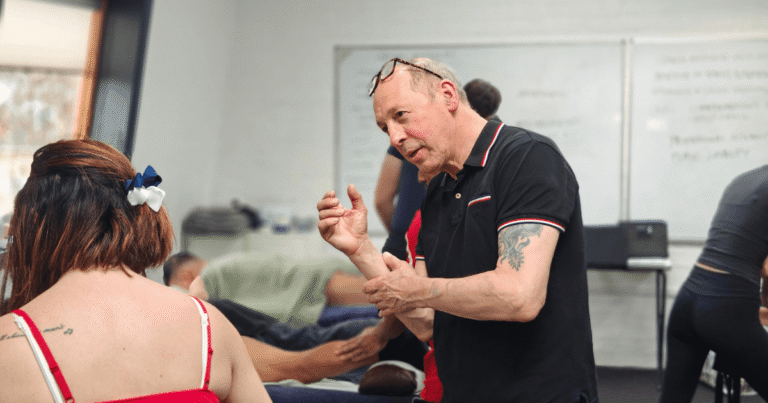
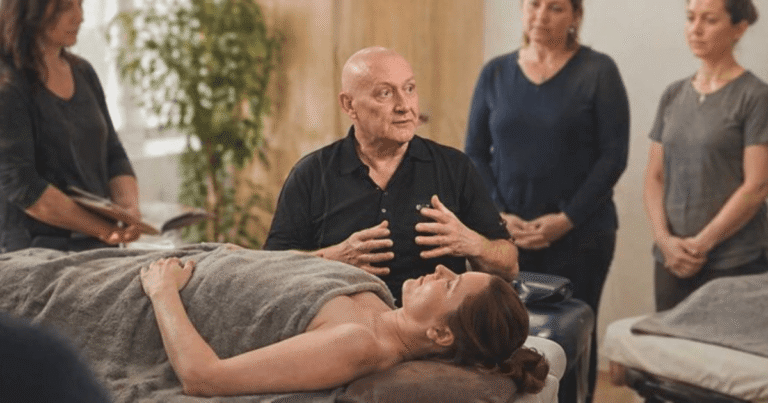
Our Level 3 course covers five units, including Functional Anatomy and Physiology, Principles of Health and Fitness, Professional Practice, Soft Tissue Dysfunction, and the practical application of sports massage treatments. It is delivered over eight weekends at our Battersea training centre in London, making it well suited to people who are working or studying alongside their training.
No prior massage experience is required. The course is open to beginners from any background, and enthusiasm and a willingness to learn are genuinely all you need to get started.
On successful completion of the exam, which includes a multiple choice theory paper and a one-hour practical assessment observed by a visiting ITEC examiner, you will hold a qualification that allows you to practise professionally, obtain insurance, and begin building a client base.
The importance of anatomy and physiology
A solid grounding in anatomy and physiology is fundamental to safe and effective sports massage practice. The Level 3 Diploma includes an anatomy and physiology unit as standard, so you will build this knowledge as part of the course. If you already hold a UK-recognised massage or holistic therapy qualification that included an A&P component at Level 3 or above, you may be exempt from repeating some of those sessions, though you would typically still attend a small number of sports massage-specific A&P classes.
For those who want to study anatomy and physiology as a standalone subject first, our ITEC Level 3 Certificate in Anatomy, Physiology and Pathology is a dedicated course that covers the subject in full and is a useful foundation for anyone preparing for clinical training.
Step two: advancing to the BTEC Level 5 Diploma
Once qualified at Level 3, many therapists choose to develop their skills further by progressing to the BTEC Level 5 Diploma in Clinical Sports and Remedial Massage. This is one of the highest sports massage qualifications available in the UK and is equivalent in standard to an undergraduate university qualification.
At Level 5, therapists develop advanced clinical skills including biomechanical assessment, joint and postural analysis, Soft Tissue Release, Muscle Energy Techniques, neuromuscular therapy, myofascial release and positional release techniques. The Level 5 is a significant step up in terms of clinical reasoning and depth of practice, and it is this level of training that opens doors to more specialist roles, including working within professional sport and multidisciplinary healthcare teams.
For beginners, we offer a two-step programme that takes you through both Level 3 and Level 5 within a ten-month period. This approach allows you to qualify at Level 3 within the first few months, begin practising and earning, and then continue your studies towards Level 5 without interruption. The two-step route is popular with career changers who want to move into practice as quickly as possible while working towards a higher-level credential.
Already hold a Level 3 qualification? The Bridging Programme
If you already hold a current, UK-regulated Level 3 or Level 4 sports massage qualification, whether earned with us or elsewhere, you do not need to repeat the Level 3. Our BTEC Level 5 Bridging Programme in Clinical Sports and Remedial Massage is designed specifically for experienced therapists who want to upskill to Level 5 standard.
The Bridging Programme runs over six months, with one weekend of study per month, and culminates in a practical examination assessed by a visiting ISRM examiner. On successful completion you will hold a BTEC Level 5 Diploma in Soft Tissue Therapy and also receive a School of Natural Therapies certificate confirming the Level 5 Clinical and Remedial Sports Massage Diploma. Graduates also become eligible for membership of the ISRM (Institute for Soft Tissue Therapists), which is widely respected within the profession.
The Bridging Programme is also open to graduates of physiotherapy, osteopathy and chiropractic, subject to an initial assessment day to determine existing hand skills and theoretical knowledge. If you are unsure whether you qualify, we are always happy to discuss your individual situation.
What qualifications will you actually hold?
The qualifications you leave with depend on the route you take.
Completing the ITEC Level 3 alone gives you an internationally recognised diploma that allows you to practise, obtain professional insurance and join industry bodies such as the FHT (Federation of Holistic Therapists). Completing the full Level 3 and Level 5 pathway awards you the ITEC Level 3 Diploma in Sports Massage, the Pearson BTEC Level 5 Diploma in Soft Tissue Therapy, a School of Natural Therapies Level 5 Clinical and Remedial Sports Massage Diploma, and eligibility for ISRM membership. Completing the Bridging Programme alone, starting from an existing Level 3 elsewhere, gives you the BTEC Level 5 and ISRM eligibility.
Where can sports massage therapists work?
One of the most appealing aspects of this career is the variety of environments in which qualified therapists can operate. Level 3 graduates commonly go on to build their own private client bases, work from home, or take up roles in health clubs, hotels, spas, gyms or sports clubs. Many work on a self-employed basis, either from a dedicated clinic space or on a mobile basis visiting clients directly.
At Level 5, the range of opportunities broadens considerably. Graduates work in multidisciplinary clinical environments alongside physiotherapists and osteopaths, within professional sports teams, and in high-performance sporting environments at national and international level. Some go on to work at major sporting events, combining pitch-side presence with clinical practice.
It is also worth noting that sports massage qualifications can be the starting point for further academic study, with the Level 5 Diploma recognised as providing a foundation for progression towards sports therapy or physiotherapy degree programmes.
A real career change: from law to Premier League football
One of our graduates, Robin Williams, is a particularly striking example of what is possible when you commit to high-quality training. After more than 37 years in the legal industry, Robin retrained with us, completing the BTEC Level 5 Diploma in Clinical Sports and Remedial Massage. He subsequently worked his way through grassroots football, building his pitch-side experience and developing complementary first aid qualifications, before eventually achieving his goal of working within Premier League football.
Robin’s own words capture it well: career change through sports massage training gave him the ability to make a meaningful difference to the people he works with. You can read his full story in our student success story: from the legal industry to Premier League football.
His journey is not unique in what it demonstrates. It is never too late to retrain, and the right qualification genuinely opens doors that would otherwise remain closed.
How long does it take to become a sports massage therapist?
At Level 3, our ITEC Diploma runs over eight weekends, typically spanning around three months. This makes it one of the more accessible routes into the profession for those with existing work or family commitments.
For those pursuing the full Level 3 and Level 5 pathway, the combined programme takes approximately ten months in total. The Bridging Programme alone, for those who already hold a Level 3, runs over six months with one weekend of training per month.
If you are wondering about the fastest possible route, our guide to the fastest way to become a massage therapist explores the options in more detail.
Can you study sports massage around an existing job?
Yes, and this is one of the reasons our courses appeal strongly to career changers. All of our sports massage programmes are delivered on weekends, which means you can continue working in your current role while you train. Many of our students hold demanding full-time jobs and manage the workload successfully, though it does require a genuine commitment to the home study and case study elements of the courses in addition to the classroom time.
Adding to your skills after qualification
For qualified therapists who want to expand their clinical repertoire after completing a diploma, we offer a range of CPD and short courses that complement sports massage practice well. These include dedicated courses in myofascial release, soft tissue release, muscle energy technique, kinesiology taping and trigger point therapy, among others. Continuing professional development is important both for maintaining professional membership and for ensuring your practice keeps pace with developments in the field.
Why train with us?
At The School of Natural Therapies, we have been training massage and soft tissue therapists since 1989. Our sports massage courses are accredited by ITEC and Pearson BTEC, and we are one of only a small number of ISRM-validated schools in the UK. Our tutors are practising clinicians who bring real-world case experience into every session, and our Level 3 course holds a 99% pass rate.
We are based in Battersea, London, and all of our sports massage training takes place in person at our dedicated training centre. If you would like to find out more about which route is right for you, or you have questions about your existing qualifications and how they might allow you to enter at a more advanced level, we would be happy to talk it through. Get in touch with us or browse our sports massage courses to find the right starting point for your journey.